The U.S. national debt is approaching $20 trillion at a lightning pace.
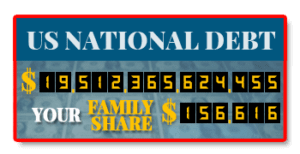
us national debt clock
Just like Times Square in New York City, we have a counter on our website that shows the actual number in real time. Though it was my idea to put this debt clock on our home page, I must admit I still find it a bit chilling to watch.
Of course, it never ever goes down. If you lived to be 80 years old, you would have to spend $700 million a day to spend the current U.S. debt!
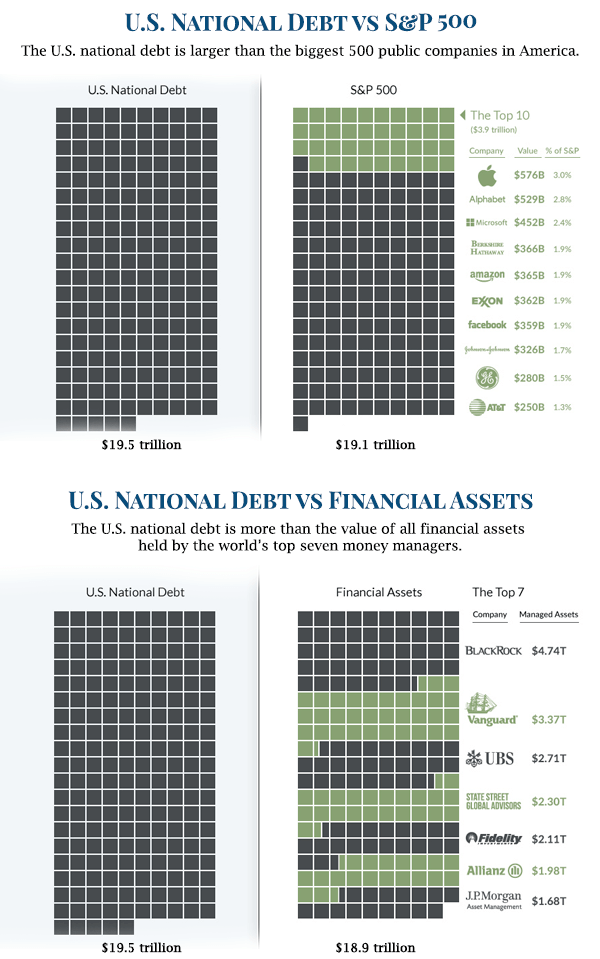
The numbers are so staggeringly large, our brains literally cannot comprehend their size. Luckily, The Visual Capitalist blog recently put these massive numbers into visual context with two charts you must see:
us national debt vs s&p 500
There are no credible plans underway to address the $20 trillion U.S. national debt. But I can assure you that it won’t be pretty for any currency- or paper-based assets like stocks and bonds when the tab becomes due and a rush to gold begins.
Are Big Banks Really Safe?
In a Brooking Institution conference last week, former Treasury Secretary Lawrence Summers and Harvard economist Natasha Sarin presented a research paper that concluded the big Wall Street banks are no safer today than they were before the 2008 financial crisis.
In fact, Summers and Sarin argued that the risks to the financial system have actually increased!
In recent years, policy makers have implemented stress tests and stricter capital requirements to try and make the big banks “safer.” But Summers and Sarin believe that there is now a probability of a major bank failing or collapsing sometime in the next few years.
Can the big banks ever be trusted? This past Thursday, Wells Fargo, one of the “too big to fail” institutions, was assessed $185 million in penalties because employees were opening up bogus bank and credit card accounts for customers without their knowledge for years.
The level of systemic fraud by Wells Fargo employees in this case is another troubling sign thatthe lessons of 2008 have been forgotten.
The Latest Gold Forecasts
Wall Street pro and former Merrill Lynch chief investment strategist Richard Bernstein is buying gold for his clients for the first time because he believes inflation is building.
According to Bernstein, recent policy statements from the Federal Reserve signal a new willingness to tolerate rising inflationary expectations. Bernstein thinks gold now has a slightly negative correlation with stocks and the precious metal could provide extra ballast to portfolios and a potential hedge against coming market volatility.
While investors wait for the Fed’s next move, the U.S. presidential election has caused uncertainty to rise, which is positive for gold. EverBank’s executive vice president Frank Trotter believes current Fed policy and the election in November are ideal conditions for gold. Trotter thinks the Fed will not raise rates this September and both Trump and Clinton will support policies that will cause gold prices to rise.
Stanley Gibbons portfolio manager Geoff Adandappa thinks gold coins are the right solution for investors concerned about market volatility, in addition to possible price gains. Adandappa believes gold coins deserve a role in every portfolio and their returns provide diversification against the stock market.
Commerzbank reported that recent gold buying data shows that investors recently have considered gold dips as buying opportunities. The bank’s analysts believe gold is a valid store of value in an environment of ultra-expansionary monetary policy and negative interest rates.
Time To Consider Your Safe Haven Strategy
Global investment demand for gold has been robust and sustained. No surprise there: gold protects privacy, is inexpensive to store and can help diversify against other financial assets.
When the next big Wall Street bank collapses or the U.S. national debt causes a loss of confidence in the U.S dollar, I believe you will be glad you own gold. Prudent investing requires that you stay prepared for every possible scenario.